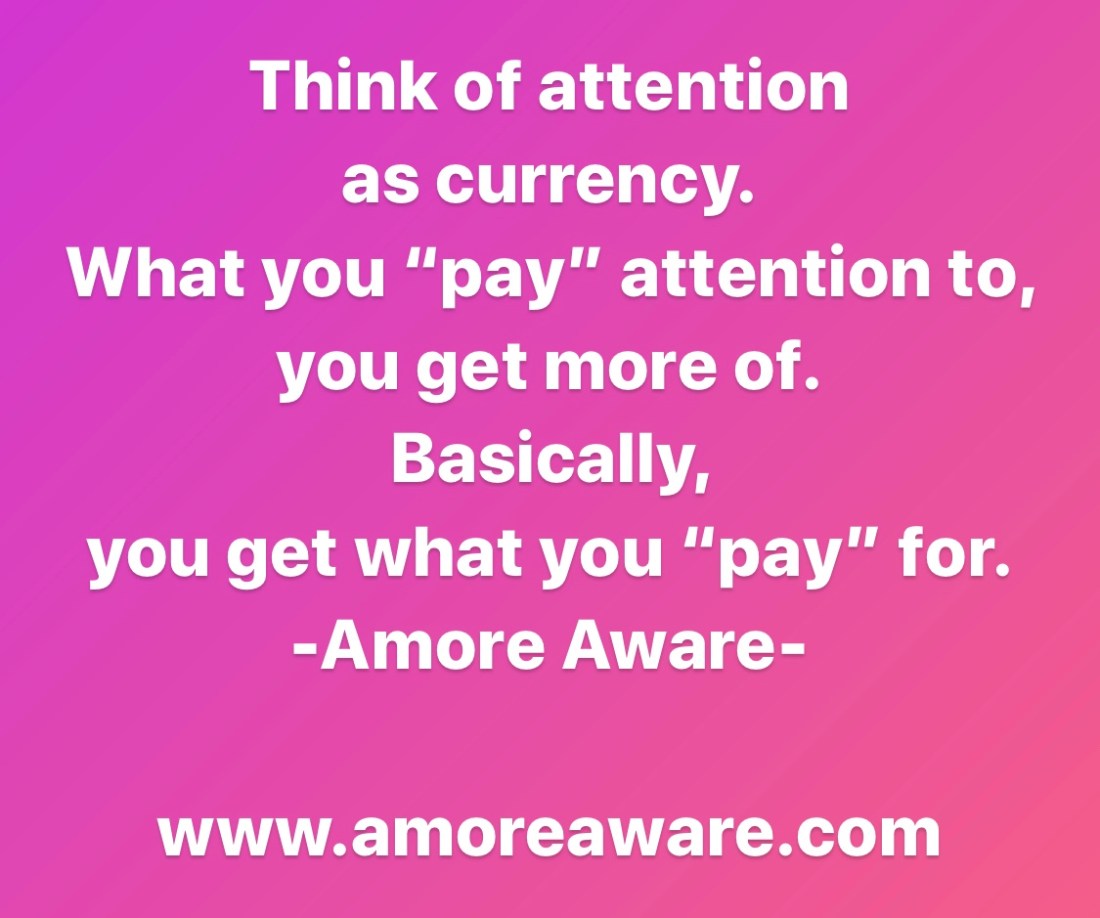
Attention…
It’s something every human being wants in one form or another. Whether it’s labeled love or money, it’s still a form of focus from one entity on another.
Attention can look like being loved, being taken care of, time spent together, and/or a paycheck for what you do as a service for others in your job, and it certainly it does not stop there.
Attention can also be paid/given to negative behaviors, and while the behaviors may be negative and undesirable, that attention can still be looked at as a reward. In other words, attention is attention, regardless of what behavior it’s addressing. It points out and highlights something that’s happening, even if what’s happening is bad.
Attention can also be connected to behaviors that are not necessarily the most adaptive. In other words, if someone else mistreats you or engages in poor behavior, and you’re constantly noticing that behavior and responding to it, then you are “paying attention” to that negative behavior. And not surprisingly, you will most likely get more of that behavior.
An example would be a child who is consistently reprimanded for his/her negative behavior but continues to engage in that negative behavior. While you may see yourself as attempting to correct the behavior as you continue to “pay attention” to the child in order to reprimand him/her, the child might see it as getting the attention he/she is looking for. He/she may then continue to behave negatively to continue to get the attention.
If we think of attention as money, basically you get what you pay for.
Quick caveat here: I am in no uncertain terms saying you should not address that negative behavior, especially when it is abusive and infringing on the rights of you and/or others. However, how you address that negative behavior has its own formula. That’s for another blog post.
What I’m saying here is that if you were to follow along with the idea of , “You get what you pay for,” you might want to “pay” your attention to when things are going well, instead of when things are falling apart.
In other words, if you want more of any particular kind of behavior, whether it be with your children, friends and/or other family members, finding the times when you see that behavior displayed in everyday life and “paying” attention to it by very specifically praising that behavior will produce greater results than “paying” attention to the times the behavior is not being displayed.
Think of attention and specific praise as currency. Spend it intentionally and wisely in your everyday experiences when things are going well. Tell people when they are behaving in a way that feels good to you and tell them exactly what it is they are doing that you like, and you will start to get exactly what you pay for.
Perks of being a counselor:
Knowing that I am always “wealthy” enough to ask for exactly what I need/want from others because there is no shortage in my ability to “pay attention” to the positive behaviors of others.
You are also wealthy enough to ask for and “pay” for what you want. 😊

 Perks of Being a Counselor